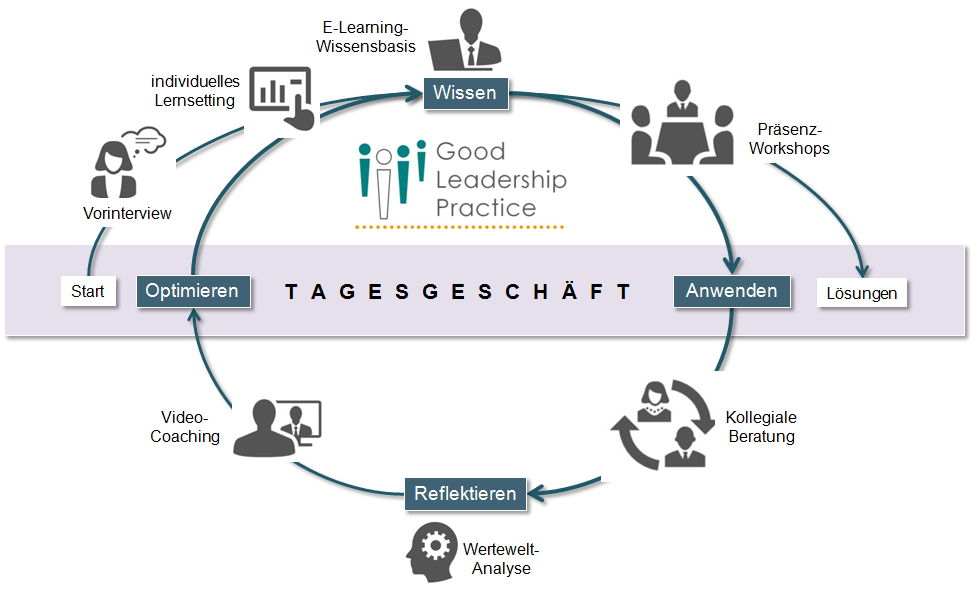
Blended learning allows you to redistribute learning time!
professore.de agrees on learning times according to the motto : Continuing education time does not have to be absence time or trainer time . New approaches are developed, allowing for sustainable yet cost-effective professional development. The core of our blended learning programs consists of in-person training sessions, typically structured as workshops. Participants meet for the workshop—well-prepared through e-learning—where trainers become coaches, addressing the individual learning needs of each participant. In this direct interaction, existing knowledge is discussed, deepened, and expanded. Tools are taught, practical exercises are conducted, experiences are shared, and problems from participants' own work are addressed. This ensures that the knowledge imparted is readily applicable , as brain research requires for sustainable learning. The workshops are preceded by self-study phases. Using our multimedia, interactive e-learning modules, learners independently acquire the necessary foundational knowledge for workshop participation. They work through tasks and case studies that reflect their actual work processes. During the transfer phases, they then test their knowledge in the workplace and clarify any questions directly with the coaching team, which provides 24/7 support.
Blended learning frees learning from the constraints of traditional frontal teaching!
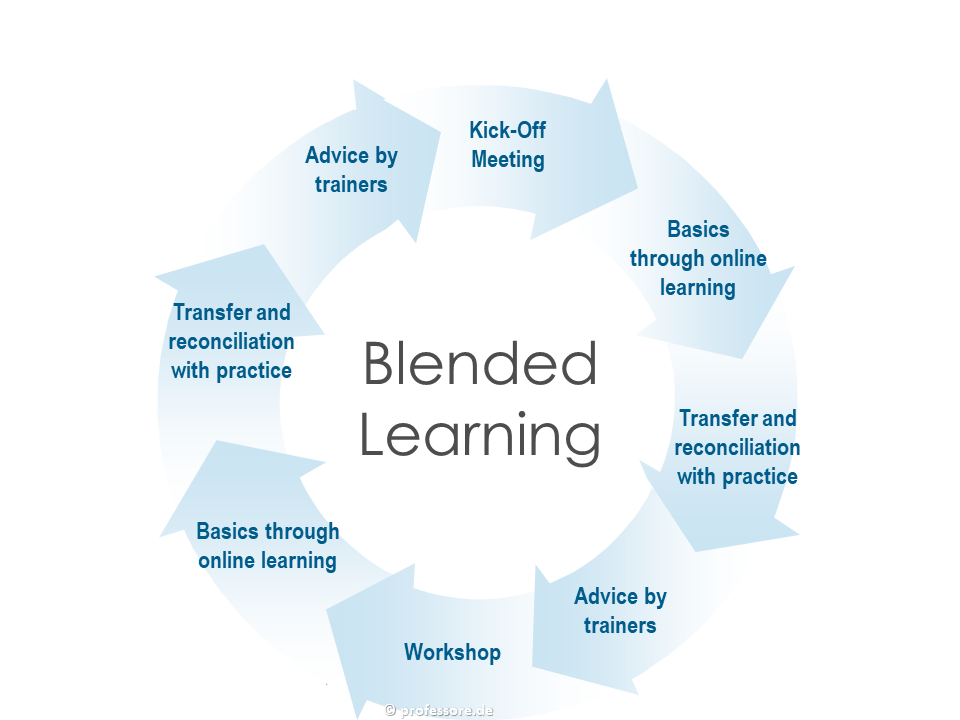
Fundamental knowledge of theories, methods, and tools is becoming increasingly important. Therefore, its teaching is playing an ever-greater role in vocational and continuing education. Unfortunately, theoretical concepts are simply not suited to being presented in a concise manner. People need considerable time to follow the thought processes of brilliant thinkers and to truly understand how the presented methods and tools function.
Therefore, with blended learning, we have separated the teaching of foundational knowledge and "packaged" it into self-study phases. The art of a professional blended learning concept lies in filtering out those learning components that can be effectively taught through self-study. E-learning, as part of the self-study phases, gives learners the time to repeat the learning content as often as they like and absorb small or large chunks according to their own preferences. Multimedia computer interactions, such as progress checks, quizzes, games, etc., support this process. Individual learning menus can be compiled from various learning objects, taking into account the learners' knowledge and expectations and accommodating different learning styles.
Blended learning is worthwhile!
Your employees are your key competitive advantage. Their knowledge increases the value of your company. Through their experience and skills, they ensure smooth business operations and customer loyalty. Investing in their development yields many times the return. However, seminars and training courses are expensive – participation fees, travel expenses, and time off for training. A single day of professional development can easily cost several thousand euros. Many companies prefer to avoid this, especially since there's no guarantee that the effort will be commensurate with the benefits. With blended learning from professore.de, these costs and employee absences can be significantly reduced. A traditional 3-day seminar comprises 24 learning hours. Including travel time, employees are absent for approximately 40 hours. A blended learning seminar of the same scope provides 40 learning hours with a total absence of 20 hours. Employees take significantly more knowledge back to the workplace, and the e-learning module can also serve as a reference tool after the seminar has concluded.
Transfer support and knowledge management with blended learning

In corporate training, the transfer of learned material into the workplace is particularly important. Blended learning offers significantly better opportunities in this regard than traditional seminars. After the in-person seminar, the learning module can be used for job-related workshops, refresher courses, coaching programs, and as an interactive reference tool. In this way, the learning module supports the transfer of knowledge into practical work. Conversely, ideas and proven solutions from the work process can also be stored in the learning module during blended learning seminars, making them available to subsequent users as experiential knowledge. The learning module can be used as a knowledge management system and dynamically expanded. Participants in the blended learning seminars offered by professore.de can directly integrate ideas, proven solutions, and experience reports from their work contexts into the e-learning module. This content is then available as practically relevant learning material. Over time, this creates a constantly growing pool of valuable experiential knowledge for the company, which can be used to optimize work processes.