DEM-I-CARE: Learning about intimacy in dementia care
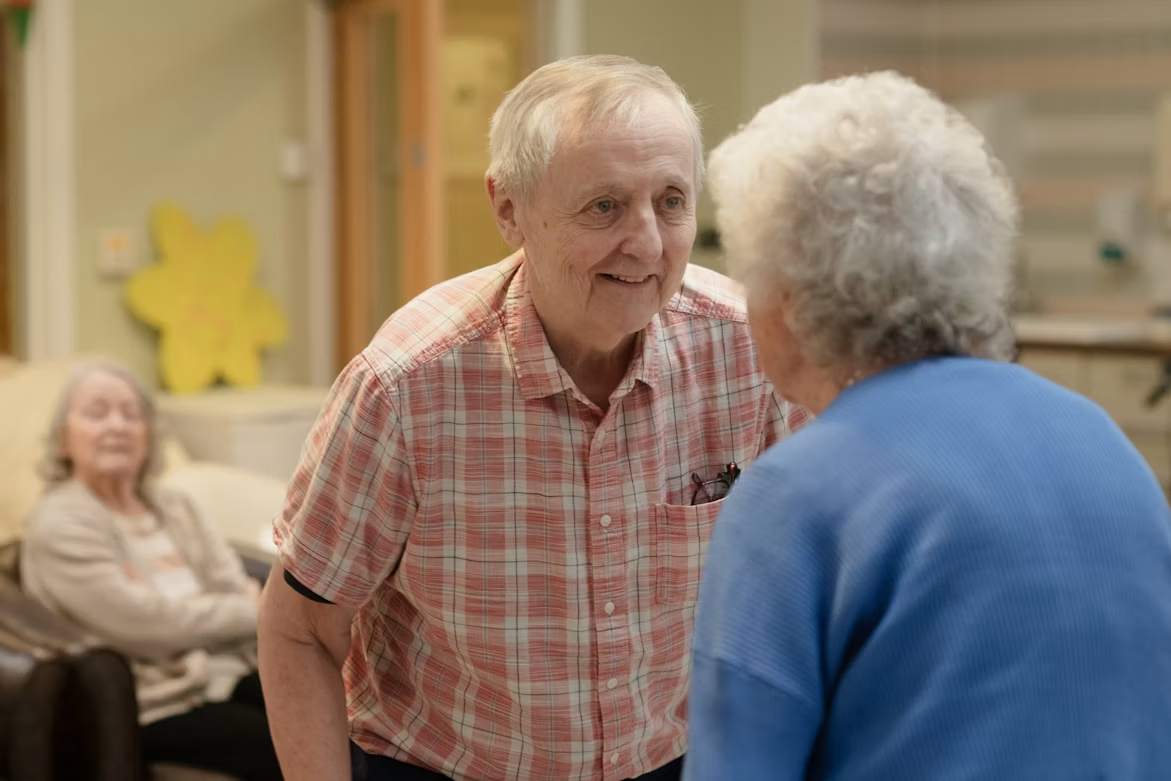

Eighty percent of people with dementia are cared for by their relatives. Most often, it is family members who look after a son, daughter, mother, or father.
Intimate needs
Approximately a quarter of people with dementia exhibit heightened intimate needs, often interpreted as sexual advances. The World Health Organization considers sexuality a fundamental human need inherent in every individual. The desire to experience intimacy and sexuality is therefore normal, but it is expressed very differently depending on cultural background. The ability to refrain from immediately acting on these needs and to balance them socially is often gradually lost in people with dementia as their illness progresses. Consequently, they frequently express their impulses much more directly than we would expect.
Irritating behavior: Impact on family caregivers
Family caregivers who have experienced such behavior often withdraw from social situations. Reasons include shame and the fear that their loved ones' boundary-violating behavior will be exposed in public. Consequently, they frequently avoid discussing their experiences with their ill relatives with other family members or professional care facilities. They then no longer leave their private environment with their relatives. In support groups, they may not be taken seriously regarding their problems.
European advisory and information project DEM-I-CARE
As part of the Erasmus+ project "Learning about intimacy in dementia care," a training program for family caregivers is currently being developed jointly in four European countries. It will also be available in Germany in the summer of 2028. The focus is on issues of intimacy and sexuality in the context of dementia, as well as on challenging and boundary-crossing behaviors that can arise in connection with the illness and with which family caregivers and professional caregivers are often confronted daily. The aim of the course is to help those affected to move beyond the taboo surrounding these topics, to make individual ways of coping with the challenges visible, and to facilitate mutual learning from the experiences of those affected for future interactions.
The project partner in Germany is professore.de GmbH with its team:

Prof. Dr. Peter Berger
Project management
info@professore.de

Prof. Dr. Andrea Berger-Klein
Project Manager
andrea@professore.de
The overall project is led by the Alzheimer Society Ireland in Dublin. Other project partners are Alzheimer Siedlce in Poland and Leyden Academy on Vitality and Aging in the Netherlands.
First project steps
Many questions
What might such a training program for family caregivers of people with dementia look like? Which teaching and learning methods would be suitable? How can virtual course components, such as videos, e-learning, or mobile learning, be integrated? How can we create a safe space where experiences with challenging behavior can be shared? What cultural specificities regarding intimacy and sexuality need to be considered for the various countries of the European Union where the course is to be offered?
Many ideas
This involves shaping teaching/learning relationships in which confidentiality and respect prevail:
On the one hand, a certain level of commitment is desirable to strengthen trust within the learning group; on the other hand, there should also be opportunities for withdrawal.
We want to present facts about the reasons for the search for intimacy among people with dementia, but avoid overwhelming them.
We want to create a safe space so that those affected can talk about their experiences with the irritating behavior of their relatives, and we want to give a voice to people who have tried strategies for resolving conflicts; solutions and possibilities should become visible and encourage people to try out new strategies themselves.
Ultimately, it is also about initiating a change of perspective, shifting the focus away from one's own fear and shame towards more understanding and communication.
The course will include case studies and fictional scenarios, as well as instructional videos from experts.
The course is designed to provide good access to peer-to-peer groups and advisory institutions.
Of course, the course must be suitable for the target group. This means we have to take into account differences in prior knowledge, time constraints, attitudes, self-determination, and motivation.
Furthermore, the course must be practical for the target group's everyday life. We must anticipate that some potential participants have withdrawn from social situations. They may have a strong need for interaction. At the same time, resignation and helplessness can also hinder active participation. For these reasons, learning methods must be found that offer low-threshold access to the courses and can be easily used in everyday caregiving situations without requiring prior membership in a mandatory learning group.
Your cooperation is required!
To answer these questions and contextualize our ideas, we are currently in discussions with care facilities, support groups, associations, and family caregivers. If you also find our project interesting and would like to give a voice to taboo topics in dementia care, you are invited to share your current issues, questions, and experiences with us and contribute to the project.
Questions about this topic? Reach out to us - the intro call is free and without obligation.
Schedule callComments
No comments yet. Be the first!