Understanding leadershipDecember 4, 2015
Understanding leadership – Part 12: Grasp the principle of division of labour!

The principle of division of labour
Division of labour happens in two stages:- The work process is broken into individual steps.
- Partial tasks are assigned to different people who thereafter perform only that partial task.
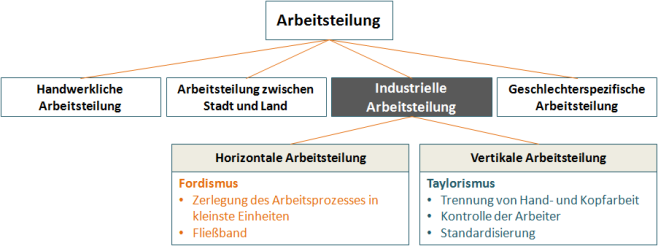 Thus craft division of labour arose organically from specialisation in trades; town–country division from societal differentiation; gender-specific division as cultural and historical.
Factory work and industrial division of labour
Industrial division of labour arose with factory work—splitting work into tasks within a process, turning workers into "detail workers" (cf. Braverman 1985, pp. 63 ff.). Two categories:- Horizontal division — Fordism, assembly line.
- Vertical division — Taylorism, separation of manual and mental work.
Horizontal division of labour
Characterised by breaking processes into smallest steps—beyond functional and occupational division. Steps are split so workers specialise in segments, creating unskilled repetitive partial tasks. Its technological synonym is the assembly line.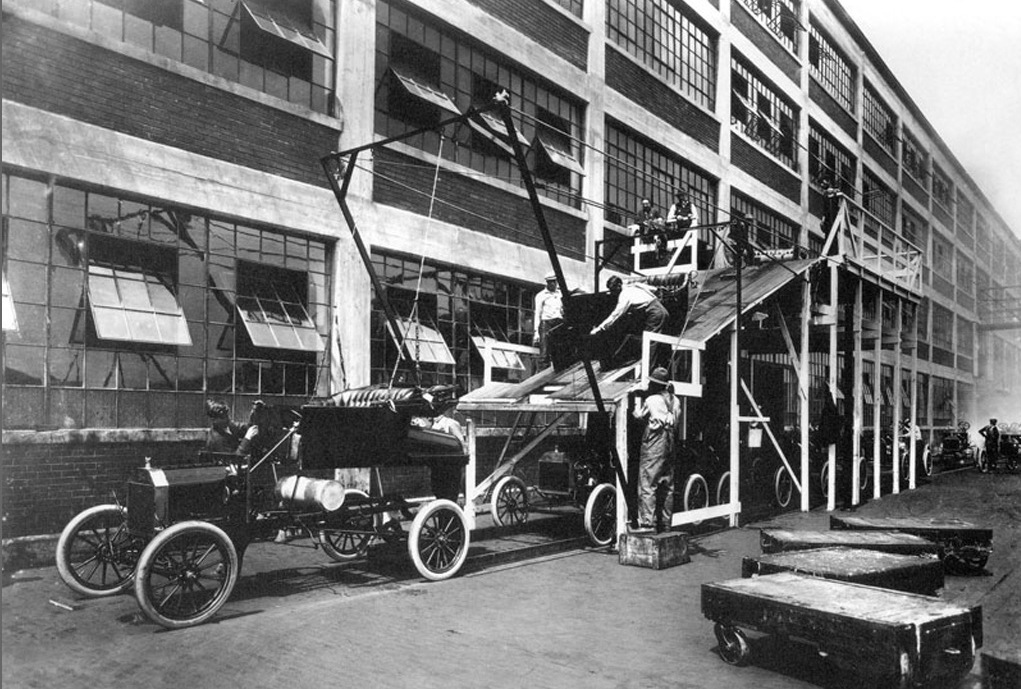 Babbage described the economic advantage of wage differentiation through splitting work into smallest steps:
"…any attempt to explain low factory prices as a result of division of labour would be incomplete without noting that the industrial entrepreneur, by splitting tasks each requiring different skill or strength, can buy exactly the amount needed for each task; whereas if one worker did all the work, they would need enough skill for the hardest and enough strength for the most strenuous part." (Babbage 1833, p. 175, cited in Braverman 1985, p. 70)
Vertical division of labour
Marked by separating planning and execution, shifting work knowledge from worker to management, which plans all steps and controls execution. Its organisational synonym is Taylorism.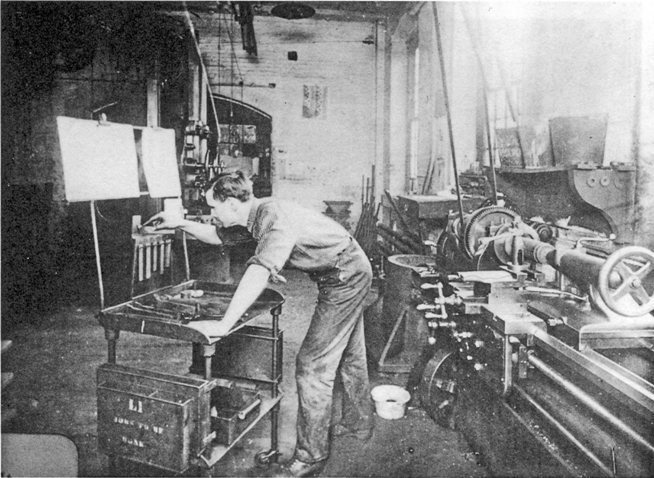 Taylorism rests on separation of manual and mental work. Taylor on vertical division:
"It falls to managers to gather knowledge once held only by individual workers, classify it in tables, form rules and formulas to help the worker in daily work." (Taylor 1983 (1919 reprint), p. 33) "All mental work under the old system was done by the worker from personal experience. Under the new system it must be done by management according to scientific laws. (...) Clearly a different man is needed for mental work and another for manual work." (Taylor 1983 (1919 reprint), p. 40) "Only by compulsory introduction of uniform methods, best tools and conditions, and compulsory cooperation of management and workers can faster pace be secured—and that can only be management's task." (Taylor 1983 (1919 reprint), pp. 86 f.)Introducing a major IT system today involves long, complex, sometimes conflictual redesign of work organisation. As-is processes are captured and to-be processes modelled for seamless system function. Change management often means new job descriptions. Those who still want to co-design hit "system boundaries" quickly. But do we still want to co-design? Perhaps everything is already optimally regulated in technical systems? In Work 4.0, are we still in control?
Teilen:
Questions about this topic? Reach out to us - the intro call is free and without obligation.
Schedule callComments
No comments yet. Be the first!